Best plug-in home battery backup (2026)
Best plug-in home battery backup for 2026: five power stations that back up home circuits without an installed system, read from their own datasheets.
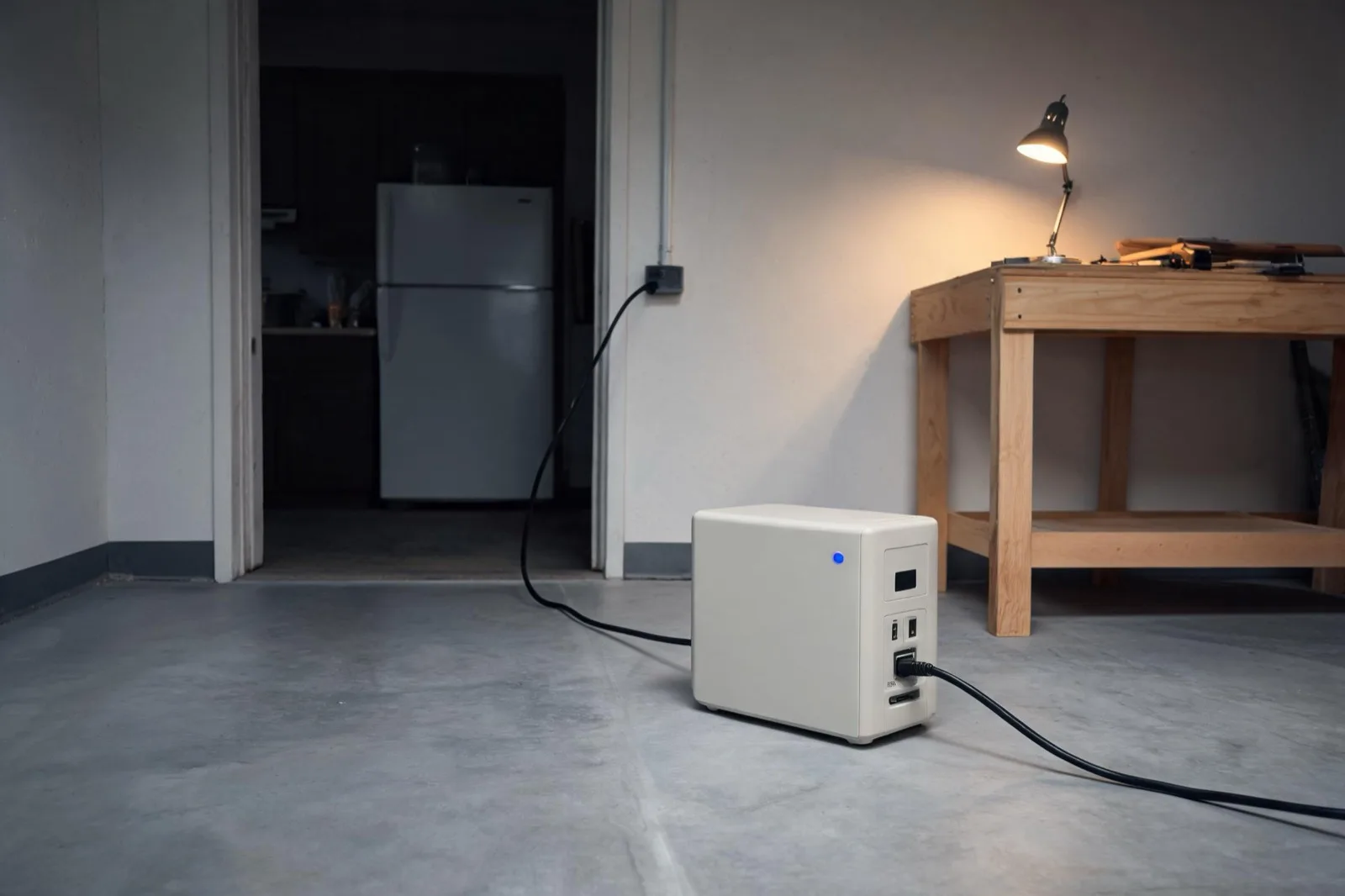
Amazon links below are affiliate links: if you buy through them we earn a commission at no extra cost to you. As an Amazon Associate, The Home Battery Report earns from qualifying purchases. Commissions never change a pick; rankings are set from the datasheets first.
4,096 Wh rated capacity with 4,000 W continuous output across its 120V and 240V ports, an 8,000 W surge, a published 10 ms UPS switchover, and expansion to 12 kWh on one unit.
6,000 W maximum output, delivered only through its 240V-capable NEMA L14-30R port (each 120V outlet group tops out at 2,400 W), from a 3,840 Wh base unit that accepts expansion batteries.
- Jackery Explorer 5000 Plus (with Smart Transfer Switch)Battery plus hookupAmazon (affiliate link, opens in a new tab)
5,040 Wh in one box, 7,200 W maximum through its 240V ports with a 14,400 W surge, and the listing bundles Jackery's Smart Transfer Switch for circuit-level hookup.
7,200 W continuous with a 10.8 kW surge and 6,144 Wh per battery, expandable to 30 kWh on a single inverter. A two-piece inverter-plus-battery system, the closest here to installed scale.
2,764.8 Wh with 3,840 W maximum output, a 7,680 W lifting (surge) rating, and a published 6,000+ cycles to 80 percent capacity, the longest cell-life rating of the group.
Every figure is a manufacturer datasheet spec. We have not lab-tested these units.
Most of this site covers installed home batteries: systems an electrician wires into your panel. This guide covers the other path, the one that starts with a delivery box instead of a permit: plug-in power stations big enough to back up real home loads. The five picks above are the strongest home-backup units we could verify from manufacturer spec sheets as of July 2026. Every figure below comes from the maker's own published spec table, quoted with the basis the maker states. We have not lab-tested any of these units, and the Amazon links above are affiliate links, disclosed at the top of this page.
How we picked
The field is crowded with camping-grade units, so we cut it on the specs that matter for a house:
- 240V split-phase output on the unit itself. A 120/240V-rated output, typically a NEMA L14-30R or 14-50 port, is what lets a unit feed a transfer switch or carry a 240V load like a well pump. Every pick here publishes a 120/240V output. Units without a published 240V output, like Goal Zero's Yeti PRO 4000, were excluded for that reason alone.
- Continuous output around 4,000 W or more (one exception: BLUETTI's Apex 300 at 3,840 W earns its slot on cycle life). This is the steady figure that carries running loads, and we exclude software boost modes: EcoFlow advertises 6,000 W with X-Boost on the DELTA Pro 3, but the hardware rating is 4,000 W, so 4,000 W is what we print.
- A real spec table on the manufacturer's own site. A number we could not trace to the maker's published specs is recorded as not published, never estimated.
- Current models, purchasable on Amazon. Each pick was checked live in July 2026. All five are LFP (lithium iron phosphate) chemistry, and all five makers publish 5-year warranty terms. Jackery's applies only when buying directly from Jackery.com, per its own footnote, a condition worth knowing next to any retailer link, including ours.
Where the headline watts actually live
The single most useful thing the spec tables reveal is that the headline number and the wall-style outlets are different stories on most of these units:
| Unit | Maximum output | Where the maximum lives | 120V wall outlets | Surge |
|---|---|---|---|---|
| EcoFlow DELTA Pro 3 | 4,000 W | Combined total across 120V and 240V output | Same 4,000 W combined budget | 8,000 W |
| Anker SOLIX F3800 Plus | 6,000 W | 240V-capable NEMA L14-30R port only | 2,400 W per outlet group | Not published for the Plus |
| Jackery Explorer 5000 Plus | 7,200 W | L14-30R and 14-50 ports | 3,600 W combined (four outlets) | 14,400 W |
| EcoFlow DELTA Pro Ultra | 7,200 W continuous | Not broken out in this guide | Not broken out in this guide | 10,800 W |
| BLUETTI Apex 300 | 3,840 W | Not broken out in this guide | Not broken out in this guide | 7,680 W ("lifting power") |
The practical read: if your plan is extension cords to a fridge, a freezer, and a router, every unit here has power to spare. If your plan is the headline number, the 240V port and a transfer switch are part of the plan too.
Surge ratings follow the same discipline. EcoFlow publishes 8,000 W (DELTA Pro 3) and 10.8 kW (DELTA Pro Ultra), Jackery publishes 14,400 W, and BLUETTI publishes 7,680 W under its "lifting power" label. Anker does not publish a surge figure for the F3800 Plus in its spec table (it publishes 9,000 W for the base F3800, a different configuration), so we do not print one for the Plus; treat its 6,000 W as the number you size against.
Capacity and expansion: read the footnote
Every maker in this group headlines a system-maximum capacity that requires more hardware than the unit you are buying:
The advertised system maximums, 48 kWh (EcoFlow DELTA Pro 3), 53.8 kWh (Anker), 60 kWh (Jackery), 90 kWh (EcoFlow DELTA Pro Ultra), and 58 kWh (BLUETTI), all require additional stations or inverters beyond the unit you are ordering, which is why the chart does not draw them. BLUETTI's Apex 300 accepts up to six B300K batteries per unit but publishes no single-unit kWh total. (Jackery has begun rebranding its line "HomePower 5000 Plus"; both names refer to the same 5,040 Wh unit.)
None of this is misconduct, but the marketing figure and the box you are ordering can be 40 kWh apart. Size against the single-unit column.
Switchover and cycle life: mind the basis
Two more places where the fine print matters:
- UPS switchover is mode-dependent on three units. See the FAQ below for the split; the short version is that "0 ms" usually names the online-UPS mode, and on the DELTA Pro Ultra the online-UPS socket bank is 120V only.
- Cycle-life ratings use different floors. The ratings look similar on paper, but they are not measured against the same bar:
| Unit | Cycle rating | Rated to |
|---|---|---|
| BLUETTI Apex 300 | 6,000+ cycles | 80% remaining capacity |
| EcoFlow DELTA Pro 3 | 4,000 cycles | 80% remaining capacity |
| EcoFlow DELTA Pro Ultra | 3,500 cycles | 80% remaining capacity |
| Anker SOLIX F3800 Plus | 3,000+ cycles | 80% remaining capacity |
| Jackery Explorer 5000 Plus | 4,000 cycles | 70% or better - a lower bar |
Match the pick to your home
| Your situation | The pick | The deciding spec |
|---|---|---|
| One box that does most things well | EcoFlow DELTA Pro 3 | Flat 10 ms published switchover (the only figure here with no mode qualifier), native 240V, 4,096 Wh |
| A well pump, dryer, or other 240V load | Anker SOLIX F3800 Plus | 6,000 W - provided the load runs off its L14-30R port |
| The battery and the hookup in one order | Jackery Explorer 5000 Plus | The listing bundles the Smart Transfer Switch; the other four picks are bare units |
| Edging toward installed-system scale | EcoFlow DELTA Pro Ultra | Grows to 30 kWh without a second inverter - then compare against installed systems |
| Daily cycling, not just outages | BLUETTI Apex 300 | 6,000+ cycles to 80 percent, the longest published rating of the group |
Two of these rows deserve a sentence more. The Jackery bundle matters because the four other picks are bare units: the transfer switch is a separate purchase and a separate decision. And if the DELTA Pro Ultra's 30 kWh ceiling is what draws you, you are already shopping at installed-system scale, so compare it honestly against the systems on our batteries page before ordering.
The honest limits
A plug-in unit is not an installed system. It will not automatically carry your whole panel, its capacity is a fraction of a stacked installed system, and a multi-day outage still requires solar panels or a generator to refill it. Prices move often on these products, which is one reason we publish none here; check the listing for the current number. And every figure in this guide is a manufacturer datasheet claim, recorded with its published basis, not a measurement we made. When you are deciding between this path and an installed battery, the complete backup guide and the whole-home backup guide are the right next reads.