Portable power station vs home battery: which backup fits
Plug-in power stations vs installed home batteries: what each can actually back up, the transfer switch question, and why neither gets a federal credit in 2026.
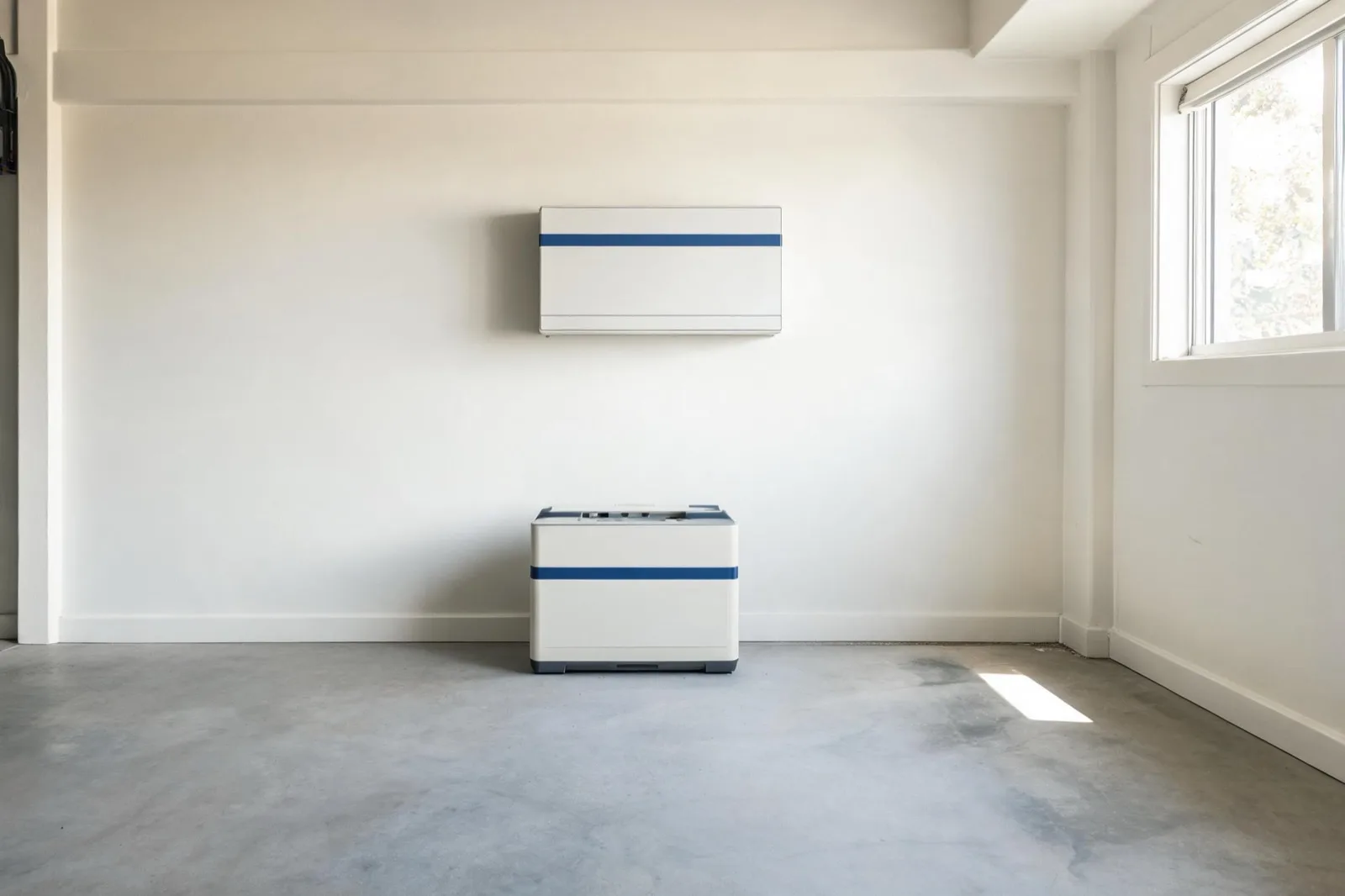
Two very different products get sold to the same worried homeowner. One arrives in a delivery box and works that afternoon. The other needs an electrician, a permit, and usually a utility interconnection. Both are marketed with the same word, backup, and both quote capacity in kilowatt-hours, which makes them look more comparable than they are.
This guide sets them side by side honestly. We cover both categories: the plug-in units in our plug-in backup guide and the installed systems across the rest of the site. The comparison below sticks to what makers publish and what the wiring physically permits, because that is where the two categories genuinely part company.
What each one actually is
A portable power station is a self-contained box with cells, an inverter, and outlets. You plug appliances into it. The strongest home-backup units publish a 120/240V split-phase output, typically on a NEMA L14-30R or 14-50 port, which is what lets them feed a transfer switch or drive a 240V load. Nothing is wired into your house unless you choose to add that hookup later.
An installed home battery is a fixed system: cells, an inverter, and a gateway or backup panel wired into your electrical service. It detects a grid outage and takes over automatically, it can be programmed to charge and discharge on your rate schedule every day, and it is a permitted piece of building electrical work. The models we track publish warranty terms of roughly 10 to 15 years, which tells you what kind of asset it is meant to be.
That last difference is the one people underweight. A power station is a device you operate. An installed battery is infrastructure that operates itself.
Cost class
We do not publish prices for power stations, because listing prices on those products move constantly and a stale number is worse than none. Check the current listing.
For installed systems, an honest planning figure is that a home battery commonly runs roughly $10,000 to $20,000 installed before incentives. Our cost guide breaks down what drives the spread.
What is worth understanding is where the money goes, because the categories differ structurally, not just in size. On the installed path you are buying hardware plus electrical labor, permitting, inspection, and a utility interconnection. On the plug-in path you are buying hardware only, with no permit, no inspection, and no interconnection, and no electrician at all unless you add a transfer switch. That structural gap, not just capacity, is why the two categories sit in different price classes. And it is why the moment you add a transfer switch to a power station, you have started paying for a piece of the installed path.
What each one can back up
This is the comparison that actually decides most purchases, and it has two halves: how much power, and for how long.
| Portable power station | Installed home battery | |
|---|---|---|
| Continuous output | Around 4,000 W and up; the headline often lives on the 240V port only | Under 4 kW to over 12 kW, published as one system figure |
| Single-unit capacity | Roughly 2.8 to 6.1 kWh, expandable with battery modules | Roughly 5 to 18 kWh usable; most systems stack |
| Switchover | Backs up what is plugged in; automatic only with the right hookup | Automatic, including when nobody is home |
| Installation | None; arrives by delivery | Electrician, permit, usually a utility interconnection |
| Hardwired 240V loads | Only via an electrician-installed transfer switch | Yes, wired into the panel |
| Daily rate shifting | Manual; a device you operate | Programmable on your rate schedule |
| Federal credit, 2026 cash purchase | None; Section 25D expired end of 2025 | None either; only the 48E lease or PPA path survives |
Power. The plug-in units we researched publish continuous output around 4,000 W and up, but on several of them the headline figure lives only on the 240V port. Anker's SOLIX F3800 Plus publishes 6,000 W maximum through its L14-30R port while each 120V outlet group is rated 2,400 W. Jackery's Explorer 5000 Plus publishes 7,200 W through its 240V ports while its four 120V household outlets are rated 3,600 W combined. If your plan is extension cords, you should size against the outlet rating, not the marketing number. Installed systems publish their continuous output as a single system figure because the whole thing is wired as one, and across the models we track that runs from under 4 kW to over 12 kW.
Duration. The runtime math is the same for both, and it is the formula from our backup guide: usable kWh divided by average load in kW gives you hours. What differs is the numerator. Single-unit capacity on the plug-in side runs roughly 2.8 to 6.1 kWh among the units we researched, expandable with additional battery modules. On the installed side, the models we track publish roughly 5 to 18 kWh usable per unit, with several of the largest published as up-to maximums rather than fixed usable figures, and most systems stack.
Put those together and the practical division looks like this. Essentials at around 0.5 kW average, meaning a fridge, lights, a router, and device charging, is comfortably inside a single power station's range for many hours. A whole-house load averaging 2 to 3 kW with heating or cooling running drains a single power station fast and is the case installed systems are built for. Deciding between whole-home and essential backup upfront tells you which category you are actually shopping.
Automation. An installed system switches over by itself, including when you are not home. A power station backs up whatever is plugged into it at the time, unless you have added a transfer switch. If the outage happens while you are at work, that difference is the entire product.
Transfer switches and the electrician question
The middle ground between the categories is real, and it is worth naming clearly.
You can have an electrician install a manual or automatic transfer switch, or a compatible backup panel, and connect a power station's 240V output to it. That lets the unit feed selected circuits in your panel, including hardwired loads like a furnace fan or a well pump that you cannot safely reach with an extension cord. This is the only safe way to run those loads, and it is not a do-it-yourself job.
Three honest notes on that path. First, it re-introduces the electrician you were avoiding, which changes the cost comparison. Second, the switchover is still not automatic in the way an installed system is, unless the specific hookup provides it; some products publish UPS switchover figures that carry mode qualifiers, so read the spec table rather than the headline. Third, capacity does not change: the transfer switch lets you feed circuits, it does not add stored energy.
If you find yourself specifying a transfer switch, a backup panel, and expansion batteries, it is worth pricing an installed system as a genuine alternative rather than assuming the plug-in route is automatically cheaper at that scale. Our battery comparison pages are where to make that check.
Neither one gets a federal credit in 2026
This is the cleanest fact in the comparison, and it removes an argument that used to favor the installed path.
The Section 25D residential clean energy credit, the 30 percent federal credit that applied to a qualifying home battery purchase, expired on December 31, 2025. A 2026 cash buyer gets $0 federal. That is true for an installed home battery and true for a power station. If you are reading a page that still promises 30 percent off a 2026 purchase, it has not been updated.
One federal path survives, and it does not help the plug-in side. A lease or power purchase agreement can let the provider capture the Section 48E commercial credit and pass some of that value through in the pricing. That structure is offered on installed, professionally financed systems. We are not aware of it being offered on a power station you order at retail. We cover exactly what changed in the 2026 battery tax credit guide.
State and utility programs are a separate matter and worth checking either way, but they generally target permanently installed, utility-interconnected storage rather than a portable appliance. Check the actual program rules for your state on the state pages before you assume a power station qualifies for anything.
Choosing between them
| Your situation | The honest pick | Why |
|---|---|---|
| Short, infrequent outages; a fridge and a few devices; you rent or expect to move | Power station | Working this week, no permits, and it moves with you |
| Backup must engage while you are away; daily time-of-use work; whole-panel coverage including 240V; solar refill | Installed home battery | Automation and scale are the product you are buying |
| Multi-day outages are the real worry | Either, plus a refill path, or a generator | Stored energy runs out in both categories; refill decides day two |
Three of those situations have their own deeper reads: when a home battery is not worth it covers the honest cases where the installed system does not pay, time-of-use rates explains the daily work an installed battery does between outages, and the battery vs generator guide works through the multi-day refill trade properly.
The way to break a tie is arithmetic rather than preference. Write down the loads you actually want to keep on, the hours you want to cover, and your real outage history. Then run your own rates through the Worth It calculator. If the installed system does not pay back on your rate plan, that is a genuine answer, and a power station covering your essentials may be the more honest purchase. If it does pay back and you want automation, no amount of stacking power stations gets you there.